
TEF Blog
Common TEF listening mistakes: 2026 guide for non-native speakers
Common TEF listening mistakes: 2026 guide for non-native speakers

TL;DR:
- Common TEF listening mistakes include not previewing questions and confusing similar-sounding numbers and negations. Practising with diverse accents and managing your time effectively are essential to avoid losing points. Guess rather than leave answers blank and simulate real test conditions to build listening resilience.
Common TEF listening mistakes are specific, repeatable errors that cause non-native French speakers to lose points during the Test d’Évaluation de Français listening section. These errors are not random. They follow predictable patterns: poor time use, confusion over numbers and negations, and too little exposure to native-speed French. Recognising these patterns before exam day is the single most reliable way to protect your score. TEFGuide has worked with thousands of candidates preparing for Canadian Language Benchmark targets, and the same listening errors appear again and again.
1. What are the most frequent errors in TEF listening comprehension?
The most damaging common TEF listening mistakes fall into five clear categories. Each one is avoidable with the right preparation.
Not reading questions before the audio plays. The TEF listening section gives you a brief window before each audio track begins. Candidates who skip this step go into each clip without a target. They hear everything but retain nothing useful. Reading questions before audio is one of the most reliable strategies for improving comprehension scores.
Confusing similar-sounding numbers and negations. French numbers like quinze and cinquante, or negations like ne…pas and ne…plus, sound similar at native speed. Number confusion frequently impacts performance in TEF Section B, especially with prices, times, and quantities. This is one of the most consistent listening comprehension errors among non-native speakers.

Ignoring the prep time between tracks. Many candidates sit passively between audio clips. That silence is preparation time. Use it to skim the next set of questions.
Panicking after missing one answer. Missing a question mid-exam causes many candidates to spiral. They spend the next 10 seconds replaying the missed clip in their heads while the next audio plays. Accepting a missed question and resetting immediately is the correct strategy.
Practising only with slow or scripted French. Textbook audio is clean, slow, and nothing like the TEF. Candidates who train exclusively with slow resources arrive unprepared for the pace of the actual exam.
Pro Tip: Before each practice session, write down which of these five errors you made last time. Targeted repetition beats general review every time.
2. How neglecting regional accents hurts your TEF listening score
The TEF listening section includes speakers from multiple French-speaking regions. Québécois French, African French dialects, and metropolitan French all appear in the exam. Failure to practise with diverse accents causes real difficulty on test day, particularly for candidates who have trained exclusively with standard European French.
Many candidates are surprised by this. They prepare with textbook recordings from France and then encounter a Québécois speaker mid-exam. The vocabulary, rhythm, and pronunciation shift enough to cause hesitation and lost points.
The fix is straightforward:
- Listen to Radio-Canada daily for Québécois French at native speed
- Watch French African news broadcasts to expose yourself to different rhythms
- Use podcasts from multiple French-speaking countries, not just France
- Avoid replaying audio when practising. The TEF plays most clips only once, so replaying during practice creates a false sense of readiness
Candidates need 30–60 minutes of native-speed listening daily to adapt to the pace and variety of the actual exam. That is not a suggestion. It is the minimum effective dose for meaningful improvement.
Pro Tip: Set your phone’s default podcast app to Radio-Canada and listen during your commute. Passive exposure to Québécois French adds up fast.
3. Why time management failures cause so many listening errors
Poor time management is behind a large share of common TEF mistakes. The exam structure makes this worse than candidates expect.
Most audio clips in the TEF listening section play only once. There is no replay button. Candidates who arrive without a time management plan lose points not because they lack French ability, but because they are always one step behind the audio.
| Common time management error | What actually happens | Better approach |
|---|---|---|
| Reading questions during audio | You miss spoken content while reading | Preview questions before audio starts |
| Overthinking one answer | You miss the next audio clip entirely | Choose your best answer and move on |
| Writing full words in notes | Note-taking falls behind the speaker | Use abbreviations and symbols |
| Leaving blanks when unsure | Zero points guaranteed | Guess. There is no penalty for wrong answers |
Effective time management requires using the brief window between tracks to preview upcoming questions. Candidates who do this consistently outperform those who do not, even when their French level is similar.
The most important mindset shift is accepting imperfection. You will miss questions. Every strong candidate does. The goal is to minimise the damage by staying present for the next clip rather than dwelling on the last one.
4. How over-analysing questions causes you to lose more points
Over-analysis is one of the quieter but more damaging listening comprehension errors on the TEF. Candidates lose points by over-analysing difficult questions, and the cost compounds: while they are stuck on question 12, question 13’s audio plays and disappears.
The TEF does not reward careful deliberation during the exam. It rewards preparation before the exam and quick decisions during it. If you did not catch the answer, your best guess is better than a blank. The TEF carries no negative marking. Wrong and blank answers both score zero, which means guessing gives you a 25–33% chance of earning points. Leaving a blank gives you zero percent.
Train yourself to make a decision within two seconds of each question ending. Write something. Move forward. This is a skill, and it gets easier with practice.
5. What practical steps prevent common TEF listening errors
The most effective preparation combines realistic practice conditions with targeted skill drills. Here is what works:
- Train with full-length timed mock tests. The absence of replay during the exam is a key challenge. Simulate it in practice by never replaying audio during mock tests. TEFGuide offers over 100 full mock exams built to match the real exam format.
- Practise dictation weekly. Dictation drills improve recall of numbers, dates, and proper nouns, which are the exact details candidates most often miss. Write out what you hear, then check for accuracy.
- Always guess rather than leave blanks. With no penalty for wrong answers, a guess is always the better choice. Build this habit during practice so it becomes automatic on exam day.
- Develop a shorthand system for notes. Create your own abbreviations before the exam. For example, use “w/” for avec, “nb” for numbers, and arrows for directions or comparisons.
- Think in French, not in your first language. Translating in your head adds a processing step that slows you down. The more you practise responding to French directly in French, the faster your comprehension becomes.
- Review every error after each mock test. Do not just check your score. Identify which question type caused the error and why. Adjust your next practice session accordingly.
Key takeaways
Avoiding common TEF listening mistakes requires practising at native speed, managing time deliberately, and always guessing rather than leaving blanks.
| Point | Details |
|---|---|
| Preview questions before audio | Use every second of prep time to read upcoming questions before the clip plays. |
| Train with diverse accents | Practise with Québécois and African French daily, not just standard European French. |
| Never leave a blank answer | Guessing gives a 25–33% chance of points; blanks guarantee zero. |
| Reset after missed questions | Accept the miss, move on immediately, and stay focused on the next audio clip. |
| Simulate real exam conditions | Practise with full-length timed tests and never replay audio during mock sessions. |
What I have learned from watching candidates fail the TEF listening section
After working with TEF candidates across many preparation cycles, I can tell you the listening section is rarely lost on French ability alone. The candidates who struggle most are often the ones who practise the most but practise the wrong way.
The biggest pattern I see is over-reliance on comfort. Candidates find a French podcast they like, listen to it for weeks, and feel prepared. But if that podcast is slow, scripted, or always the same accent, it builds false confidence. The TEF will throw a Québécois speaker at you in the middle of the exam, and that comfort evaporates.
The second pattern is emotional. Candidates who miss a question early in the listening section often lose the next two or three because they cannot let it go. Resilience during the exam is a skill you have to build deliberately, not something that shows up automatically on test day.
My honest advice: spend less time listening passively and more time listening actively under pressure. Do timed drills. Make yourself guess. Get comfortable being uncomfortable with the audio. That discomfort in practice is exactly what protects your score on exam day. Perfection is not the goal. Strategic preparation is.
— Reza
How TEFGuide can help you fix your listening score
Knowing your errors is the first step. Fixing them requires the right practice environment.
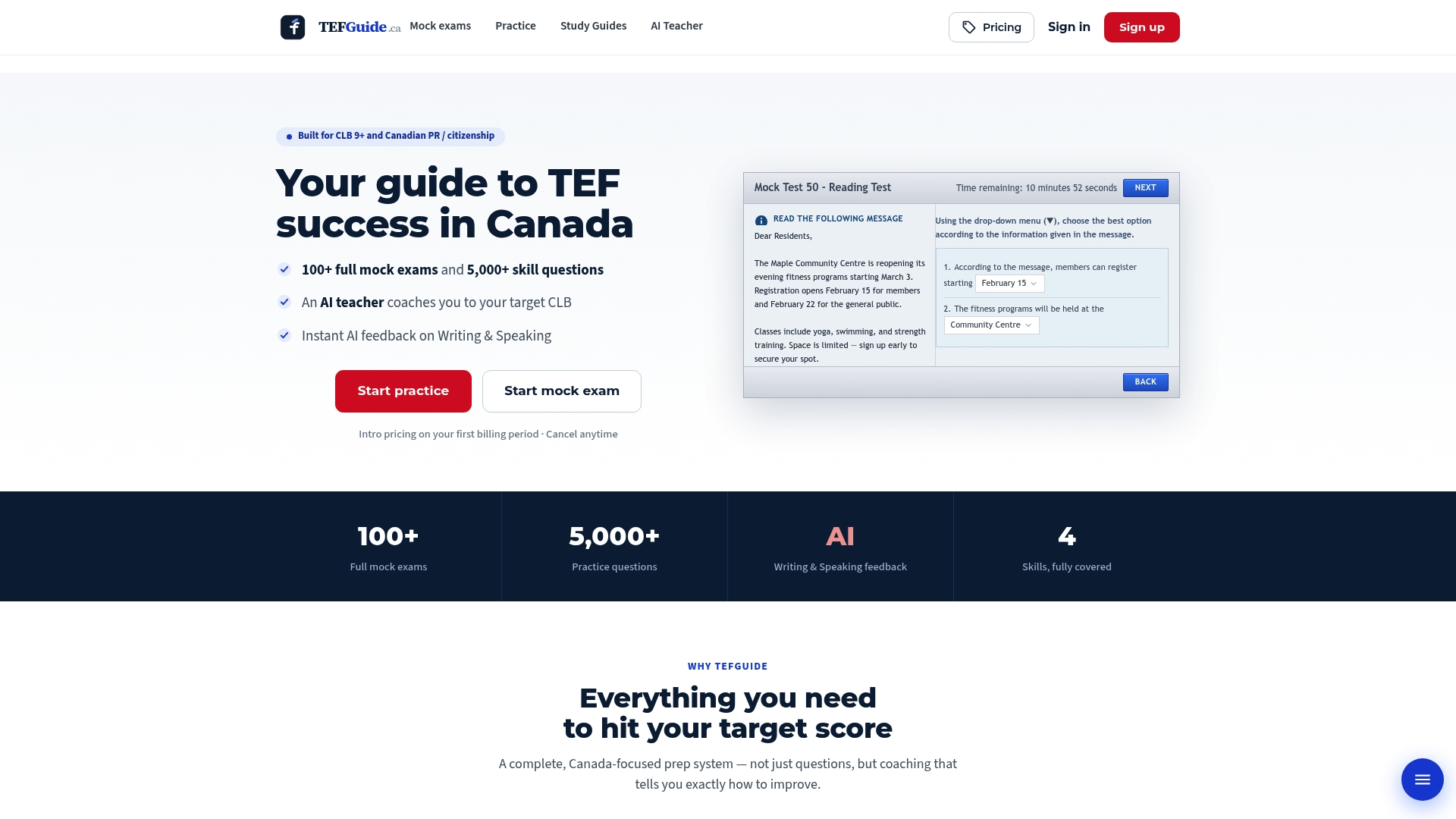
TEFGuide offers over 100 full TEF practice tests built to match the real exam format, including timed listening sections that play audio only once, just like the actual TEF. The platform’s AI-driven coaching system gives you instant feedback after each session, so you know exactly which error types to target next. With more than 5,000 practice questions across all four skills, you can build the listening stamina and accuracy needed to hit your Canadian Language Benchmark target. Thousands of candidates have used TEFGuide to reach their CLB goals. Your preparation starts here.
FAQ
What are the most common TEF listening mistakes?
The most frequent errors include not previewing questions before audio plays, confusing similar-sounding numbers and negations, and panicking after missing one answer. These are consistent patterns across non-native speakers at all French levels.
Does the TEF listening section penalise wrong answers?
No. The TEF carries no negative marking, so wrong answers and blank answers both score zero. Always guess if you are unsure, since guessing gives you a 25–33% chance of earning points.
How much daily listening practice do I need for the TEF?
Candidates need 30–60 minutes of native-speed French listening daily to adapt to the pace and accent variety of the exam. Sources like Radio-Canada are particularly effective for Québécois French exposure.
Why do regional accents matter on the TEF?
The TEF listening section features speakers from multiple French-speaking regions, including Québec and parts of Africa. Candidates who practise only with metropolitan French often struggle to understand these accents during the exam.
How do I stop over-analysing questions during the TEF listening section?
Train yourself to decide within two seconds of each question ending. Write your best guess and move to the next clip. Build this habit during mock tests so it becomes automatic on exam day.