TEF Blog
How to identify TEF weak areas as a student
How to identify TEF weak areas as a student

Identifying your TEF weak areas is the first step toward achieving the Canadian Language Benchmark score you need. The Test d’Évaluation de Français assesses four skills: oral expression, oral comprehension, written expression, and written comprehension. Most students lose points in one or two of these areas without realizing it, because their study habits do not reflect real exam conditions. A structured TEF proficiency evaluation, built around mock tests and honest self-review, gives you the data you need to study smarter, not just longer.
How to identify TEF weak areas students struggle with most
The TEF measures four distinct language skills, and each one presents its own challenges. Understanding where students typically fall short helps you recognise your own patterns faster.
| TEF skill area | Common weak areas |
|---|---|
| Oral expression (speaking) | Hesitation fillers, limited vocabulary, poor time management |
| Oral comprehension (listening) | Fast speech, unfamiliar accents, missing key details |
| Written expression (writing) | Grammar errors, weak structure, thin vocabulary |
| Written comprehension (reading) | Slow reading speed, misreading context, vocabulary gaps |

Oral expression is where self-taught learners underperform most often. Passive study, such as watching French videos without speaking aloud, does not build the fluency the exam demands. Listening comprehension trips up students who have only practised with slow, scripted audio. Written expression suffers when students write without time limits, which creates a false sense of competence. Reading comprehension gaps often come from vocabulary weaknesses that slow down processing speed under pressure.
Recognising these patterns is the foundation of any effective TEF student performance analysis. Once you know which skill costs you the most points, you can direct your effort where it counts.
How do mock tests reveal your TEF performance gaps?
A full mock TEF exam is the most reliable diagnostic tool available. Taking a full mock test four to six weeks before your exam date establishes a baseline score across all four skill areas. That baseline shows you exactly which sections drag your overall result down.
After completing the mock test, review each section separately. For oral expression, listen back to your recorded responses and count how many times you used filler words. Monitoring filler words like “euh” during oral practice is a direct indicator of fluency problems under pressure. For written expression, compare your response against a model answer and note every grammar or vocabulary difference.
Reading and listening sections require a different review approach. Mark every question you got wrong, then identify whether the error came from vocabulary, speed, or misreading context. Grouping errors by type turns a raw score into a clear action plan.
Pro Tip: Record your oral responses under timed conditions from your very first practice session. Reviewing those early recordings reveals hesitation patterns and grammar errors you cannot hear in real time.
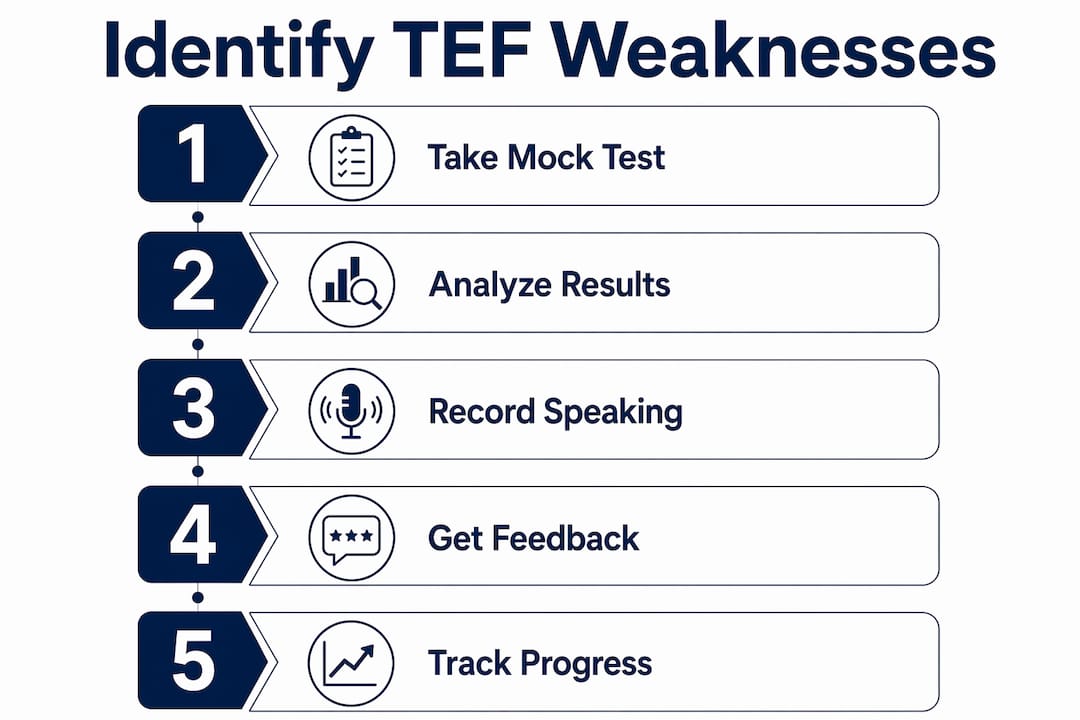
Here is a step-by-step self-assessment process you can follow after each mock test:
- Score each section separately and record the results in a tracking sheet.
- Review oral recordings and count filler words, pauses longer than two seconds, and repeated grammar errors.
- Read through written responses and highlight every grammar mistake, weak word choice, and structural gap.
- For reading and listening, categorise wrong answers by error type: vocabulary, speed, or comprehension.
- Rank your four skill areas from weakest to strongest based on the combined evidence.
- Write one specific goal for your weakest skill before starting your next study session.
This process turns a single mock test into a detailed map of your TEF weak areas assessment. Repeating it every two weeks shows whether your targeted practice is actually closing the gaps.
What tools help you track TEF progress and analyse weaknesses?
Tracking your progress requires more than memory. The right resources give you consistent, comparable data across study sessions.
| Resource type | Primary benefit |
|---|---|
| Full mock tests with instant scoring | Baseline data and section-by-section comparison |
| Vocabulary banks by topic | Reduces hesitation in writing and speaking tasks |
| Writing correction services | Uncovers grammar and structure errors you miss yourself |
| Speaking practice platforms | Builds fluency and reveals pronunciation patterns |
| Study trackers and planners | Keeps weak-area focus consistent over weeks |
Building a vocabulary bank for common TEF topics, including work, housing, services, travel, and social situations, directly reduces hesitation during timed writing tasks. A topic-based vocabulary list also prepares you for oral expression prompts, which frequently draw from the same subject areas.
Writing correction is one of the most underused resources among students preparing for the TEF. Self-review of writing consistently misses vocabulary gaps and recurring grammatical errors that a tutor or correction service can identify. Submitting written practice for external feedback uncovers organisational weaknesses that are invisible to the writer.
Tefguide offers over 100 full mock exams with instant scoring across all four TEF skill areas. The platform’s AI-driven coaching system provides immediate feedback on writing and speaking tasks, which makes it possible to identify weak areas after every single practice session rather than waiting for tutor availability.
Pro Tip: Ask a tutor or language partner to review one oral recording and one written response per week. Outside feedback consistently reveals blind spots that self-review misses.
Combining quantitative scores from mock tests with qualitative feedback from tutors or AI coaching gives you the clearest picture of your actual performance gaps. Pairing open feedback with scores deepens understanding of where repeated issues cluster, which makes your study plan far more targeted.
Common mistakes when identifying TEF weaknesses
Students make predictable errors when trying to analyse their own performance. Knowing these pitfalls helps you avoid them.
- Practising without time limits. Writing without time pressure fails to prepare you for the 30–45 minutes you have under exam conditions. Relaxed practice produces results that do not reflect your real exam performance.
- Ignoring oral fluency under pressure. Many students sound fluent in casual conversation but freeze or fill silences with “euh” when a timer is running. This gap only shows up during timed recording practice.
- Treating a low score as a complete explanation. A raw score tells you that something is wrong, not what caused it. Low results require investigation beyond the number itself, including a review of the specific question types and error patterns behind the score.
- Focusing only on your strongest skill. Students naturally gravitate toward what they do well. Spending most of your time on a skill that already meets the CLB threshold wastes preparation time that your weakest skill needs.
- Skipping the review step after mock tests. Completing a mock test without reviewing errors produces no diagnostic value. The review is where the actual learning happens.
- Relying on passive exposure alone. Listening to French podcasts or reading articles is useful background practice. It does not replace active production tasks like timed writing or recorded speaking.
Each of these mistakes delays accurate weakness identification. Correcting them early means your study time produces real gains instead of false confidence.
How to prioritise weak areas for better TEF results
Once you have identified your weakest skill areas, the next step is allocating your study time accordingly. Students who devote 60–70% of preparation time to their weakest sections see the most significant score improvements before exam day.
Follow this prioritisation process:
- Rank your four TEF skills from weakest to strongest using your mock test baseline scores.
- Assign 60–70% of your weekly study hours to your bottom one or two skill areas.
- Use the remaining time to maintain your stronger skills with lighter practice.
- Set a specific, measurable target for each weak area, such as reducing filler words to fewer than three per minute in oral practice.
- Repeat a full mock test every two weeks to measure whether the gap is closing.
- Adjust your time allocation based on the new scores. If one weak area improves, shift focus to the next weakest skill.
For oral expression, targeted drills mean timed speaking responses on common TEF topics, recorded and reviewed after every session. For written expression, targeted practice means writing under strict time limits and submitting responses for correction. For listening, targeted work means practising with audio at native speed, not slowed-down learning recordings. For reading, targeted improvement comes from timed reading exercises with vocabulary review of every unfamiliar word encountered.
Consistent, focused repetition in your weak areas produces compounding gains. Each session builds on the last, and your mock test scores will reflect that progress within two to three weeks of disciplined practice.
Key takeaways
Identifying your TEF weak areas through timed mock tests, recorded oral practice, and external feedback is the most direct path to higher CLB scores.
| Point | Details |
|---|---|
| Use mock tests as diagnostics | Take a full mock test 4–6 weeks before your exam to establish a baseline across all four skills. |
| Record oral responses every session | Listening back reveals filler words and grammar errors that are invisible in real time. |
| Get external writing feedback | Tutors and AI coaching uncover vocabulary and structure gaps that self-review consistently misses. |
| Allocate 60–70% of study time to weak areas | Concentrating effort on your lowest-scoring skills produces the fastest score gains. |
| Review errors by type, not just score | Categorising mistakes by cause, such as vocabulary or speed, turns raw results into a targeted study plan. |
What I have learned from watching students prepare for the TEF
The pattern I see most often is students who study hard but study the wrong things. They spend weeks on grammar rules they already know and avoid the oral section because it feels uncomfortable. That discomfort is the signal. Oral expression is where the most points are lost, and it is the skill that improves fastest with the right kind of practice.
The students who improve their scores most quickly are the ones who record themselves from day one. Not because they enjoy hearing their own voice, but because the recording does not lie. You cannot argue with a playback that shows you said “euh” eleven times in two minutes. That kind of evidence forces honest self-assessment in a way that no amount of passive study can replicate.
I also think students underestimate how much tutor feedback changes the trajectory of their preparation. A single session where someone marks up your written response and explains the recurring patterns is worth more than a week of solo practice. The feedback loop, from practice to correction to adjusted practice, is what actually closes gaps. Without it, students tend to repeat the same errors indefinitely and wonder why their scores do not move.
The most effective TEF preparation is not the most intensive. It is the most honest.
— Reza
Tefguide: practice that shows you exactly where you stand
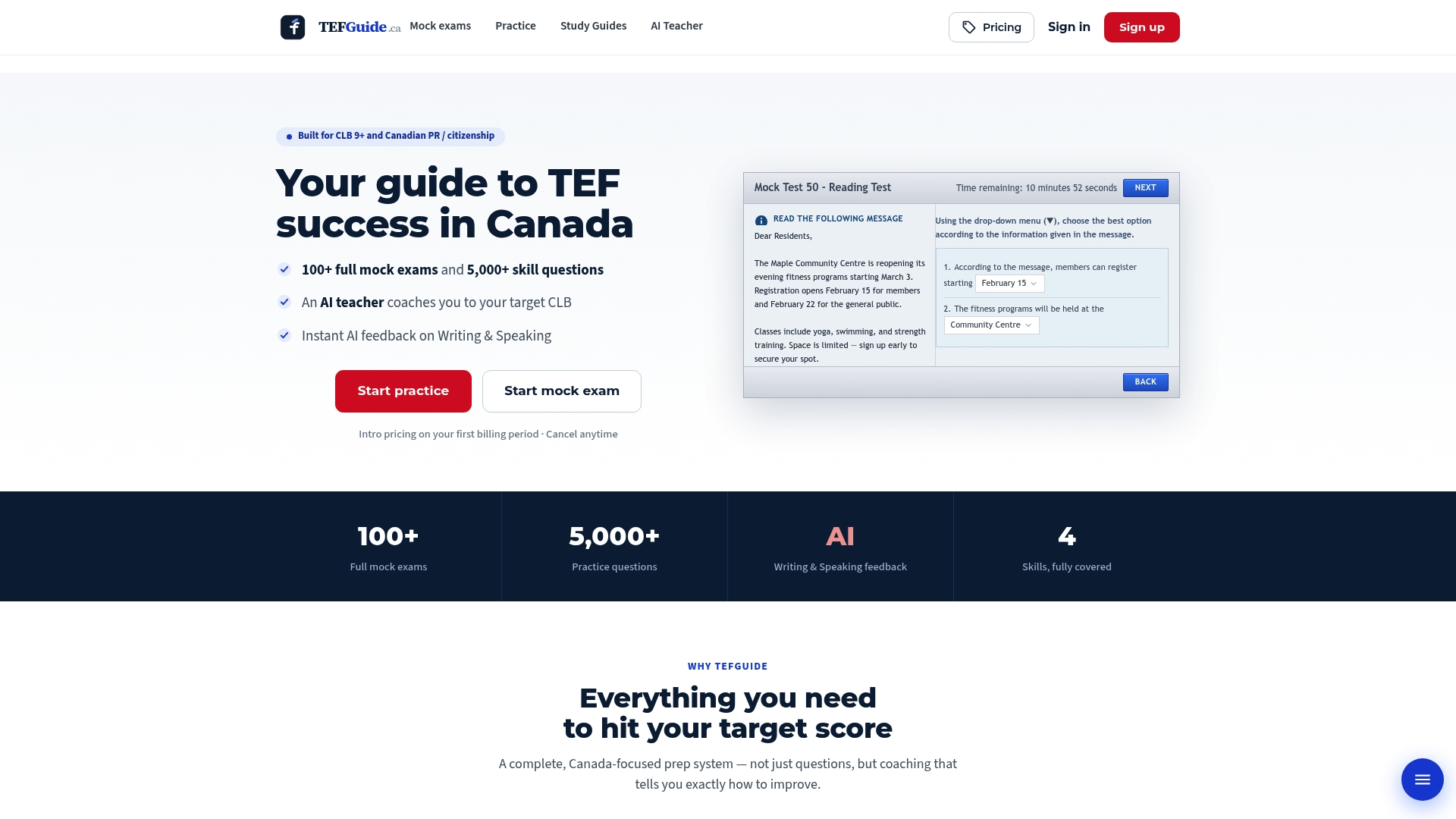
Tefguide is built specifically for students preparing for the TEF who need more than generic study materials. The platform offers over 100 full mock exams and more than 5,000 practice questions across all four skill areas, with instant scoring after every session. The AI-driven coaching system provides immediate feedback on writing and speaking responses, so you know exactly which patterns are holding your score back. Thousands of students have used Tefguide to reach their target CLB scores by following a structured, weakness-focused study plan. Start with a TEF practice test today and get your first clear picture of where your preparation stands.
FAQ
How do I find my weakest TEF skill area?
Take a full mock TEF exam under timed conditions and score each section separately. The section with the lowest score relative to your CLB target is your primary weak area.
How often should I take mock tests to track TEF progress?
Taking a full mock test every two weeks gives you enough time to practise targeted improvements between sessions while still generating regular, comparable data.
Why do I perform worse in oral expression under timed conditions?
Passive study habits do not build the fluency needed for timed speaking tasks. Recording yourself under exam-like conditions reveals hesitation fillers and grammar errors that casual practice hides.
Can I identify TEF writing weaknesses on my own?
Self-review misses most vocabulary gaps and recurring grammar errors. Submitting written practice to a tutor or an AI coaching platform like Tefguide produces far more accurate feedback.
What is the best way to improve TEF assessment scores quickly?
Devote 60–70% of your study time to your weakest skill areas and practise under timed conditions every session. Combining mock test data with external feedback produces the fastest measurable gains.